It began not with grand ambitions or a vision to rival Woodstock, but with a modest goal: to raise enough money to build a new swimming pool for the Isle of Wight. Half a century and thousands of unforgettable performances later, the Isle of Wight Festival stands as one of the most storied events in music history, a festival that shaped a generation, attracted the greatest musicians on the planet, was silenced by an act of Parliament, and then, against all odds, came roaring back…
The Birth of a Legend: 1968
The first Isle of Wight Festival took place on 31 August and 1 September 1968 at Ford Farm, near Godshill, organised by three young brothers from the Island, Ron, Ray and Bill Foulk, under the banner of their company, Fiery Creations. It was a relatively intimate affair, attracting around 10,000 people to watch a varied bill that included Jefferson Airplane, Arthur Brown, The Move, Tyrannosaurus Rex, Fairport Convention and the Pretty Things. By the standards of what was to follow, it was small and local in character, but it established something important: the idea that the Isle of Wight could host a world-class music event.
Bob Dylan Comes to the Island: 1969
If the 1968 festival put the Isle of Wight on the map, the 1969 event rewrote the map entirely. The Foulk brothers pulled off one of the most remarkable booking coups in music history, persuading Bob Dylan, then living in semi-retirement in upstate New York following a motorcycle accident three years earlier, and having pointedly avoided the Woodstock Festival held near his own home, to make the Isle of Wight his return to the stage.
The festival took place on 29 to 31 August 1969 at Woodside Bay in Wootton, and drew an audience of around 150,000 people including, reportedly, three members of The Beatles. Dylan and The Band headlined alongside The Who, Free, Joe Cocker, The Moody Blues and a host of others. The event was, by all accounts, well managed and joyful, a stark contrast to the chaos that had unfolded at Woodstock just weeks earlier. Dylan's appearance alone had made the Isle of Wight the centre of the musical universe.
The Biggest Show on Earth: 1970
The 1970 festival, held from 26 to 30 August at Afton Down in the west of the Island, remains one of the most extraordinary gatherings in the history of popular music. Guinness World Records estimated that between 600,000 and 700,000 people attended, more than had descended on Woodstock the previous year, making it the largest musical event of its time and one of the largest gatherings of human beings anywhere in the 20th century.
The line-up was staggering: Jimi Hendrix, The Who, The Doors, Joni Mitchell, Miles Davis, Joan Baez, Leonard Cohen, Emerson Lake & Palmer, Sly and the Family Stone, Chicago, Jethro Tull, Ten Years After and many more performed across five extraordinary days. It was, and remains, widely acknowledged as Europe's equivalent of Woodstock and a defining moment in the counterculture of the era.
The 1970 festival carries a particular poignancy in music history. Jimi Hendrix's performance on 31 August was his last in England. Less than three weeks later, on 18 September 1970, he died at the age of 27. The Doors' set was also among their final performances with Jim Morrison, who died in July 1971. The Island had, without knowing it at the time, hosted the closing chapter of one of music's most extraordinary eras.
Silence: The 32-Year Gap
The sheer scale of the 1970 festival had consequences. The enormous crowds, the logistical pressures and the impact on Island residents led, in 1971, to Parliament adding a section to the Isle of Wight County Council Act that prohibited overnight open-air gatherings of more than 5,000 people on the Island without a special licence from the council. In effect, it was a legislative ban that brought the festival to a halt for more than three decades.
The Island fell quiet. But the memory of what had happened there never faded. The 1970 festival passed into legend, documented in films, recordings and the testimony of hundreds of thousands of people who had been there. Hendrix's performance lived on in posthumous albums, and the mythology of the Isle of Wight Festival grew precisely because the festival itself could no longer exist.
The Revival: 2002 and Beyond
It took a promoter who had been there himself to bring it back. John Giddings, who had attended the 1970 festival as a young music fan and witnessed the colossal crowd at Afton Down, seized the opportunity to revive the event when the legislative barriers were finally lifted. In June 2002, the Isle of Wight Festival returned as a one-day event at Seaclose Park in Newport, with The Charlatans and Robert Plant headlining before a crowd of around 8,000 people.
It was modest by comparison with what had come before. But it was a beginning. Giddings, who still curates every aspect of the festival today, built on that foundation year by year, and the festival quickly regained its place as one of the most prestigious events in the British music calendar.
By 2004, David Bowie was headlining alongside The Who. From that point, the names that have graced the Seaclose Park stage read like a definitive guide to popular music's greatest acts: The Rolling Stones, Paul McCartney, Coldplay, Jay-Z, Bruce Springsteen, Muse, Foo Fighters, Pearl Jam, The Strokes, Kasabian, Kings of Leon, The Sex Pistols, Fleetwood Mac, The Police, Blondie, Red Hot Chilli Peppers, and Amy Winehouse, to name only a small selection.
A Festival Like No Other
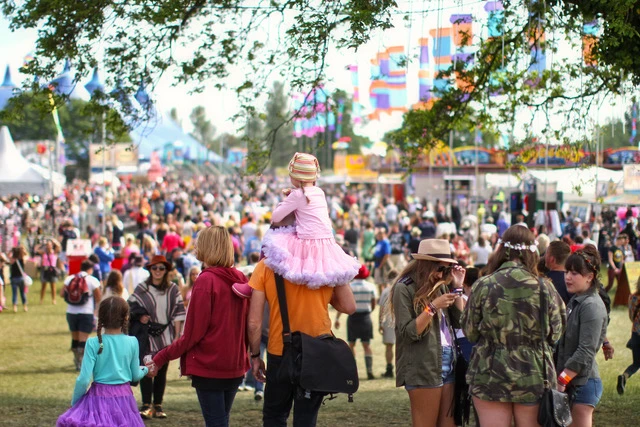
What makes the Isle of Wight Festival remarkable is not simply the quality of the artists who have performed there across nearly six decades, but the place itself. Seaclose Park, set on the edge of Newport with the Island's green hills rolling away in every direction, provides a setting that no mainland venue can replicate. Arriving by ferry, crossing the Solent as the Island comes into view, has become a ritual for the tens of thousands of festival-goers who return year after year.
The festival takes place each June and is the first major event of the British summer festival season, continuing to attract some of the biggest names in music alongside emerging talent, maintaining the balance that Giddings has always championed. It remains a gathering place, a celebration and a piece of living history all at once.
The Isle of Wight Festival 2026 takes place from 18 to 21 June at Seaclose Park, Newport.
For tickets and further information, visit isleofwightfestival.com.